Sunday, November 6, 2011

87: India Song

             Struggling through Marguerite Duras’ India Song (1975) I kept trying to entertain myself.  I thought of the well-known Four Word Film Reviews website, and did my best to apply its philosophy and style.  Below is the result.
  
“Quasi sexual self-indulgent bull”

            Here’s the gist.  The bored wife of a 1930s French ambassador to India struggles to retain her marriage (I think).  Two unseen narrators recall and discuss her interactions within her large Calcutta mansion.  At some times these voices explain what happens on screen and at others they seem to be discussing nothing in particular.  The two principle characters spend long unbroken takes in front of a mirror, saying almost nothing to each other.  At one point Michael Lonsdale (who I recognized as the guy from Moonraker (1979)), playing another diplomat, proclaims a love for the woman, shrieking his declaration from off-screen.

Admirers of this film call it nonlinear poetry.  I think it’s telling that its soundtrack, recorded separately from the visuals, was reused, completely unchanged, for Duras’ next picture.  This film is one piece of art that was pretentious and heavy-handed enough the first time around.

Language: French/Bali
Runtime: 120 Minutes
Available @ Youtube.com

Grade: .5 Hats Off

Friday, November 4, 2011

88: Turkish Delight (a.k.a. Turks Fruit – original Danish title)

            For some reason I neglected to include in my review of Marketa Lazarová (1967; #91) that it was voted in the late 1990s as the greatest Czechoslovakian film of all time.  Perhaps I left this fact out because I would have spent much of the write-up naming Czech films that are better (of which I can think of several with minimal effort).  Such national lists of movies were common at the close of the last century.  In the case of the Netherlands, Paul Verhoeven’s Turkish Delight (1973) was named the crème de la crème, and for some reason that seems appropriate.  Certainly, critics of this film will point out that it is both depraved and explicit, but neither of those factors detracts from its quality.

            Also not dragging it down was the fact that to view Turkish Delight I was forced to resort to a Spanish-dubbed version I found on Youtube.  The dubbing itself appeared to be some of the best I’ve seen, but didn’t particularly help, as I speak almost no Spanish whatsoever.  Still, for almost 24 hours now I’ve been thinking about this film, and it has only occurred to me once in retrospect that I didn’t get a single word of it.  Movies were about images long before they were ever about words, and I don’t think I missed a single major point of Turkish Delight.  In fact, after scouring the web, it appears as though the film only has one memorable line: Rutger Hauer’s sculptor protagonist Erik proclaiming “I screw better than God” – a statement that reportedly caused Hauer’s father to skip the movie.

            At the outset we see Erik approach a car on a dark street and proceed to beat its male owner to death with a blunt object before shooting his female companion in the front seat in the head.  A cut reveals that Erik is only fantasizing about this violent episode, before he pleasures himself to a photo of a woman resembling the one he’s just internally destroyed.  A montage ensues which has Erik engaging in various sexual encounters with various women; each episode a bit more disturbing that the last as he gathers souvenirs from his conquests.  A lengthy flashback details the relationship Erik once had with the woman in the photo.

            He meets Olga (Monique Van de Ven) by chance, picked up while hitchhiking by the young girl.  His insatiable sexual appetite seems to be exactly what she has been looking for as she drives radically along the highway.  After a series of sexual misadventures she wrecks the car, injuring both herself and Erik.  When he attempts to visit her to see how she is recovering, her family does all that they can to prevent him from seeing her.  Immediately her mother dismisses Erik as a bohemian influence that she would prefer to spare her daughter from.  Regardless, the two young lovers pursue their relationship.  There are tender moments between them, but there is also rather explicit sex, and neither seems to be able to get enough of it.  Erik seems to be inspired artistically by Olga.  When they marry, her family, led by her spry father, attempt to accept Erik into their lives.

            Still, there are complications, and after the death of her father Olga’s mother passively encourages her relationship with an American businessman.  In a rather disgusting scene at a restaurant, Erik picks up on the potential relationship, reacting violently before vomiting on the assembled company.  He sees Olga only several more times before she departs for the U.S. to be remarried.  Years later they meet again, but Olga seems different.  They sit for coffee and exchange pleasantries, but moments after they separate Olga collapses.  It is discovered that her lifelong erratic behavior has been brought on by a slowly growing brain tumor.  Though the tumor is surgically removed, doctors are unable to take it out in its entirety.  Olga will die.  Completely bald and weakened by treatment, she fears eating anything tougher than the Turkish delight Erik brings her; worried that her teeth might fall out if she tried.      

            Rutger Hauer is an actor in demand.  He has worked almost ceaselessly since the late 1960s and seems to have a taste for taking roles likely deemed too distasteful for other actors.  Turkish Delight is no exception.  It is a film that, to put it lightly, has its fair share of bodily functions and fluids.  Excrement and vomit are not shied away from, but Hauer’s work within this picture would hardly qualify as either.  He conveys joy, pain, humor, and horniness here in a deeper way than some might think possible with such material. With the looks of a rock star he likely could have opted for a much for convention leading man career, but then we would have missed so much from him.  In this film, her debut, Van de Ven is every bit his equal.

            Watching the first half of this film I couldn’t help but compare Verhoeven’s early work to Fassbinder.  Watching the second half, that feeling faded.  Thinking it over for a day, I’ve concluded that Fassbinder made movies for the joy of making art while Verhoeven makes movies for the joy of making movies.  Much of his later work could never have been anything but a movie, and he’s certainly made some stinkers.  But with Turkish Delight that joy is tangible.  He combined the creative forces of composer Rogier van Otterloo and DP Jan de Bont to make a film greater than its material might have deserved, and greater than the sum of its parts.  De Bont got more than he bargained for as well when, after filming her naked body for days, he married the 19 year-old Van de Ven.  They were divorced in 1988, lasting significantly longer than Erik and Olga.

Language: Dutch (Original)
Runtime: 112 Minutes
Available with Spanish dubbing @ Youtube.com (NST)

Grade: 3 Hats Off     

Monday, October 31, 2011

89: The Mad Masters (a.k.a. Les maîtres fous)

            Ethnography has to be one of the most difficult forms of filmmaking.  Certainly it’s a different task than scripting and directing action, but as a recorder of the customs and practices of another culture, one also takes on very different risks.  In the case of Jean Rouch’s The Mad Masters (1955), those risks were not fully accounted for.  Rouch was allowed to film the religious ceremonies of the Hauka sect of West Africa, and the resulting film proved controversial to say the least.

            The early footage consists of a brief slice of daily life for the Haukas, mostly migrant workers finding day labor jobs that serve the colonial economy of Accra.  As members pile into vehicles, Rouch’s voiceover explains that once a year the sect meets far outside of the city to perform their major spiritual sacrament.  At a remote location the males of the group ingest a powder that brings on hypnotized trance.  They burn their bodies with torches, foam at the mouth, spit blood, and speak in an unknown language.  Rouch’s camera is curious, but his sparse VO offers little explanation of these events, which comprise the majority of the picture’s short runtime.

            Controversy erupted as a result of Rouch’s editing in the final segment of the film, in which he equates the entranced actions of the Hauka to mimicry of their colonial oppressors.  His contention that the ceremony served as catharsis that prevented violent uprisings ultimately failed, and his film was banned in several British West African colonies.  The film also garnered criticism from African students, who claimed that it perpetrated negative stereotypes of Black African culture, and pointed to the somewhat obvious staging of its events.  Eventually, Rouch acknowledged this staging, choosing to call The Mad Masters a “docufiction”, a term he would eventually ascribe to much of his work.

Language: French (primary)/?
Runtime: 28 Minutes
Available @veoh.com

Grade: 1 Hat Off

Saturday, October 29, 2011

90: Memories of Underdevelopment (a.k.a. Memorias del subdesarrollo)

            I was surprised to learn from the 1001 text that Tomás Gutiérrez Alea’s Memories of Underdevelopment (1968) was not an independently produced post-revolutionary Cuban picture, but in fact a state-sponsored Cubano del Arte e Industrias Cinematograficios film.  So nonchalant about the political nature of its early 1960s setting in Havana, it’s hard to believe that Castro’s government not only approved of this picture, but funded its production.  Equally baffling in this context, is the picture’s focus on a single individual and his apathy to the communist overthrow of the Batista regime.

            The individual in question is Sergio (Sergio Corrieri), a former businessman whose prospects are all but destroyed by the socialist takeover.  After sending his parents and his ex-wife to Miami to avoid the violence of the coup, he remains in Havana, resolving to become a writer.  However, the conflict by which he is surrounded bores him, and he doesn’t really seem to care to write about it or anything else, other than the women who fill in his loneliness.  He laments for lost loves while spending days watching television and peeping at neighbors from his balcony, content for a time to live off of the income he makes as a landlord.  The irony of the dilapidated structures that surround his posh apartment building proves all the more odd when again remembering this film’s source of financing, and while Sergio is certainly critical of the “underdeveloped” nature of Cuba under Batista, he dismisses its current status with the same label.  

            When Sergio meets the beautiful and young Elana (Daisy Granados) and convinces her to come up to his apartment for a tryst, his lonely nature is briefly curtailed.  But as with his complaints about Cuba, he dismisses Elana as underdeveloped and uncultured.  He tries to educate her, planning trips to museums and taking her to Hemingway’s house, but she’s bored by the things that he uses to mold her into his ideal.  When her family intercedes in their relationship, claiming that he raped her and ruined her prospects, he’s forced to explain himself to a grand jury.  Acquitted of the charges he continues to wait out the revolutionary changes, only mildly optimistic that the Castro regime will bring about a better Cuba. 

            Memories of Underdevelopment contains three fantastic sequences that each, in their own way, evokes the complexities of the past, present, and future of Sergio’s Cuba.  The first is a not so subtle jab at the former regime.  As Sergio takes Elana to meet with a film director (Gutiérrez Alea) friend, they sit in a screening room watching a montage of all of the footage cut from imported films that were censored by the moralistic Batista.  In yet another staggering irony, Memories is critical of this censorship.  In another sequence, as the lovers peruse Hemingway’s personal affects, Sergio marvels as the American writer’s abilities, slightly jealous and again dismissive, claiming that the author’s possessive feelings about the island were, at best, faux romanticism.  Looking to the past, Sergio realizes the potential futility of his own future aspirations, beset with the feeling that the present might not be as glorious as some would claim either.  Finally, the film concludes with a montage comprised of news reel footage of the Cuban Missile Crisis.  Retrospectively in 1968, this was already scathing criticism of events that brought the world to the brink of self-destruction.  Both Kennedy and Castro can be heard addressing their respective people, each assuring them that their nation’s resolve for peace is equaled only by their preparedness for war. 
          
            Irony is where this picture lives, and while good films often touch on ironic themes or actions, this picture immerses itself in them.  Sergio is no more certain of a great future for Cuba at the film’s conclusion than he was at its outset, and yet the picture itself tries to be optimistic.  Memories of Underdevelopment focuses on one, rather bourgeois individual, but tries to make a statement for the proletariat.  It attempts to promote Cuban nationalism through a European-minded protagonist.  Mostly, it is critical of Cuba’s status as an underdeveloped nation, while somehow seeming to suggest that the best way to relieve this unwanted status is to blow more of Cuba up. 

            This was the first post-revolutionary Cuban film to be released in the United States.  It was shown in 1973, five years after its initial release on the island, and was selected by the New York Times as one of the best films of that year.  In what might be the saddest irony of the film, Gutiérrez Alea was not allowed a travel visa to receive a special award given to the picture by the US National Society of Film Critics

Language: Spanish (primary)/English
Runtime: 97 Minutes
Available @video.google.com

Grade: 3 Hats Off

Thursday, October 27, 2011

91: Marketa Lazarová

            I was struck by the opening sequence of Frantisek Vlácil’s Marketa Lazarová (1967).  The first moments of this 13-century medieval bohemian epic portray the desolation and unflinching cold of a time and place in a manner that is utterly visceral.  Low angle cinematography draws the audience in as voyeurs of a bandit attack on a coach, placing viewers close enough to the action that they might feel compelled to reach out and touch the frozen snowy landscape.  Unfortunately, the film peaks here, leaving nearly two and a half hours left in which it resides in narrative mediocrity. 

            Early on, I couldn’t tell whether the poorly executed additional dialogue recoding (ADR) voiceovers were intentionally echoed for a stylistic touch.  Certainly Vlácil couldn’t be justified in thinking that they were cohesive.  While I was initially intent on not letting this element of the film distract from my viewing, it became impossible to ignore when the picture’s diagetic sound took on the same obtrusive quality.  Still, I was mesmerized by the stimulation of the visual pallet which this movie offers.  Shot in a black and white that is at times stark, the film also includes sequences of an absolute dreamlike state.  It’s quite heavy on the symbolism as well, as its plot supposedly pertains to the clash between paganism and Christianity that racked Eastern Europe during the period.

            I say “supposedly” because I spent the 162 minutes of this picture’s runtime trying desperately to figure out what was going on.  Perhaps I enjoyed the opening sequence so much because the beginnings of films always breed confusion, as we get to see the characters before we really know them.  Here, I never once throughout felt that I really understood any of the characters, let alone their motivations.  War films can be difficult to follow because it’s tough to pick out certain characters when they’re all wearing the same thing.  A similar quagmire is likely to befall many a viewer of this piece of Czechoslovakian cinema, as animal skins don’t tend to be easily distinguishable on black and white film.  Add to this factor the bearded element of many of the characters herein and it leaves only the eponymous female lead and the one-armed son of a warlord who stand out amongst the crowd.

            To be fair, there are several aspects of Marketa Lazarová that work quite well.  The soundtrack, comprised primarily of vocal music that feels true to the period, evokes an element of medieval Europe that is simultaneously religious and bleak.  Surviving harsh winters and retaining long-held beliefs were the major elements of life in this time and this place, and in conveying that fact the film succeeds.  Still, it lacks an element of humanity with which most audiences could relate.  In fact, upon its preview screening Variety acknowledged the artistic merits of the picture while predicting its commercial failure, calling it “a stunning work – unsuitable for general commercial release.” (Schneider, 483) 

            Indeed, this is a style over substance work that has likely remained in the semipublic conscious due to the efforts of film snobs who can appreciate its loose (barely there) narrative.  By its conclusion, the film descends into a mess of unjustified voiceovers that confuse both the audience and the characters alike.  While the cinematic merits of this picture are high, its quasi-narrative, involving the kidnapping and rape of a young virgin who has been promised to a convent, isn’t exactly the Saturday afternoon matinee aimed at teen audiences that it might sound like.

Language: Czech
Runtime: 162 Minutes
Available @Youtube.com

Grade: 1.5 Hats Off

Thursday, October 20, 2011

92: Before the Revolution (a.k.a. Prima della rivoluzione – Original Italian Title)

            The work of Bernardo Bertolucci is never particularly easy to digest, often difficult in both structure and content.  In a peculiar irony, his most acclaimed work is perhaps his most commercial film.  1987s The Last Emperor, which took home nine academy awards, including statues for Bertolucci’s writing and directing, might be, as a foreign language film, one of the least seen Best Picture winners of that or any decade.  The Italian auteur is probably best know, or at least most discussed, in stateside film circles for his direction of Last Tango in Paris (1972), the final X –rated film to ever garner serious Oscar attention, in which Marlon Brando lubes up ingénue Maria Schneider’s rear end with a stick of butter before having his way with her.

              Bertolucci rose to prominence with The Conformist (1970), and on the strength of that Italian-language political thriller his earlier Before the Revolution (1964) was given a major release in 1971.  Foreshadowing his 1970 film, Before the Revolution is a drama with political undertones that can be exceptionally difficult to follow.  Indeed, entire segments of the development of the primary relationship in the film seem to be missing.  Though not as directly as with The Conformist, we see here the political ideologies of an individual shape and contort his personal relations, without any specific interaction between the two facets.

            The young Fabrizio (Francesco Barilli) is distraught after the death, and possible suicide, of a close friend.  He finds comfort and excitement in forming a sexual relationship with his unhinged aunt, Gina (Adriana Asti), ten years his senior, who is visiting Parma for the Easter Holiday.  The film’s slow start gives way to several beautifully composed visual and musical interludes, that using minimal dialogue partially express the progression of Fabrizio and Gina’s affair.  Their attraction is torrid, but Gina’s actions often confuse and frustrate her lover/nephew.  As his involvement with the Parma communist movement increases, his jealousy within the relationship follows suit, nearly boiling over when Gina takes him to visit an old friend of hers, Puck.

            At Puck’s serine property the older man confesses that he is no longer able to pay his mortgage, and that the land will soon revert to collectors.  Bertolucci plays his own political cards rather close to the chest in this sequence, neither fully lamenting the loss of Italy’s feudal system nor totally supporting the communist land ideal.  Regardless of politics, the scene is stunning, expressing both the beauty of the Italian landscape and the sorrow of the failing land owner.

            After Gina departs from Parma, Fabrizio is engaged to a woman from a prominent family.  He sees his former lover only once more before the wedding, staring down at her in the audience from his fiancé’s private opera box during a performance of Macbeth.  The two meet in the lobby of the opera house for a brief moment, but have little time to discuss anything before the show ends.

            Bertolucci is in many ways the director that film snobs dream about; one who “doesn’t spell everything out for you.”  This is certainly true.  Before the Revolution moves slowly at first, and then gives way to a frenzied, almost fragmented visual collage of sequences that only feel loosely connected at times.  Visually, it is absolutely breathtaking, with Bertolucci filming his hometown in a soft black and white that expresses the love of cinema which I feel is absent from the work of Buñuel.  A minor character in a short scene here tries to discuss movies with Fabrizio, and I’m overcome with the feeling that he’s meant to represent the director.  Bertolucci was only 22 when he began shooting this picture, but his lifelong love of film is already on full display.

Language: Italian
Runtime: 115 Minutes
Available @ Youtube.com

Grade: 3 Hats Off

Tuesday, October 18, 2011

93: The Man who had His Hair Cut Short (a.k.a. De man die zijn haar kort liet knippen – original Dutch title)

            I must say that director André Delvaux’s The Man who had His Hair Cut Short (1966) is an enchanting movie.  It announced the arrival of Belgian cinema into the international film forum, and created a surreal style that would become synonymous with that country’s pictures.  Like a dream it weaves an odd spell that transfixed me as I watched.  Ghislain Cloquet and   
Roland Delcour’s black and white cinematography is somehow simultaneously stark and ethereal, lending the film its airy state.  Structurally, it is an odd picture, with a lengthy segment that is only justified by later dialogue, but it retains its focus just as it is about to skip off the rails.

            Govert (Senne Rouffaer) is a respected teacher at an academy for girls – Mr. Miereveld to his students.  The film opens as he contemplates the graduation of his senior class, particularly the gorgeous Fran (Beata Tyszkiewicz), whom he has secretly loved for years.  She’ll be leaving his life without ever knowing what she has meant to him.  Gorvert prepares for the day’s festivities in his study, hoping that the book he’s ordered for Fran has come in.  His wife sends his daughter in to bring him his tea, but he has other things on his mind.  Wanting to look his best, he stops at the barber before proceeding to the ceremony.  As you might expect, despite not being particularly handsome he takes great pride in his appearance, ordering the strait razor shave and the tightly kempt cut. 

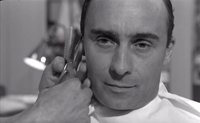
            There’s an element to the haircut scene that could feel like heavy-handedness to some viewers, but that I felt was spot on.  Tight close-ups of the meticulous process add an intimacy to the relationship between man and barber, and by association bring the audience closer into the nature of this meticulous man.  Once the process is complete he’s off to school, arriving just a moment too late to the ceremony.  He sits in his place, hoping as the retirement and service awards are handed out that Fran will glance just once in his direction.  The look never comes and he is devastated.  He searches for her frantically after the commencement, but misses her time and again, getting only to view her from afar as she sings a song about inevitable endings during a goodbye concert. 

            Years later, having left the school with a broken heart, Govert finds himself working as a legal clerk.  He’s convinced to join a medical officer of the count on a trek to autopsy a body that was found adrift, and may be a missing bank examiner.  This is the odd sequence of the film that doesn’t seem to fit, and yet I don’t know that it could be easily cut.  While most of the gory details of the procedure are obscured by the wooden casket walls, the audience is forced to suffer along with Govert as his imagination makes the process torturous.  Finally, with the evidence inconclusive, the medical investigators call it quits.  Deciding to stay in the town for the night, the men all get rooms at a posh hotel.  Unnerved by the events of the day, Govert’s mood changes abruptly when he encounters Fran on the hotel stairs. He immediately launches into an explanation of the autopsy before realizing that he has almost spoiled her appetite as she heads for the dining room. Later in his suite he envisions a rendezvous between himself and Fran, but what actually takes place changes his life in a much more profound way by connecting all of the pieces that have come before.

            The Man who had His Hair Cut Short isn’t a long film, but it is a deep picture.  It manages to fit philosophy and guilt and an odd redemption into its quick pace.  It is beautiful aesthetically and poignant thematically without ever even approaching a preachy dynamic.  It is simply the story of one man’s ability to fool himself into thinking that a woman could in some way attain perfection.  Like so many great tragic films the pain here comes from the obsessions of a character and the illusions that he allows himself to believe.  At once both real and dreamlike, The Man who had His Hair Cut Short is a testament to the power of self-deception and the tardiness of self-realization.

Language: Dutch
Runtime: 94 Minutes
Available @ Youtube.com

Grade: 3.5 Hats Off